
WHEN A MAN LOVES A WOMAN
By Peter Lee
There is an old saying that tragedy can strike like lightning. Sadly, this is not just a saying. It really does happen in real life.
Recently, we read the heartbreaking news of three policemen who were electrocuted while harvesting coconuts. Apparently, one of them was using an iron rod when lightning struck the rod. His two colleagues tried to help him, but sadly, all three lost their lives.
Anyone, including myself, who watched the video clips and news coverage of one of the policemen’s funeral would have been lost for words.
His wife and five young children, aged between 4 and 11, were crying uncontrollably in front of his coffin.
I cannot imagine what would have been going through our minds if we were in her shoes.
Her greatest concern was understandably the future of her five young children their education, daily living expenses and how she would cope financially, especially as she is a low-income earner in the private sector.
She had to appeal to the government, elected representatives and others for financial assistance to help her family through this difficult period.
A true and sad story like this reminds us that we simply do not know what can happen tomorrow.
One can be here today and, in the blink of an eye, be taken away from the people we love, leaving them shocked, confused and helpless.
Under such circumstances, the first thing that would probably come to a widow’s mind is:
“How am I going to feed my children?”
“How am I going to pay the bills?”
“How am I going to pay for their education?”
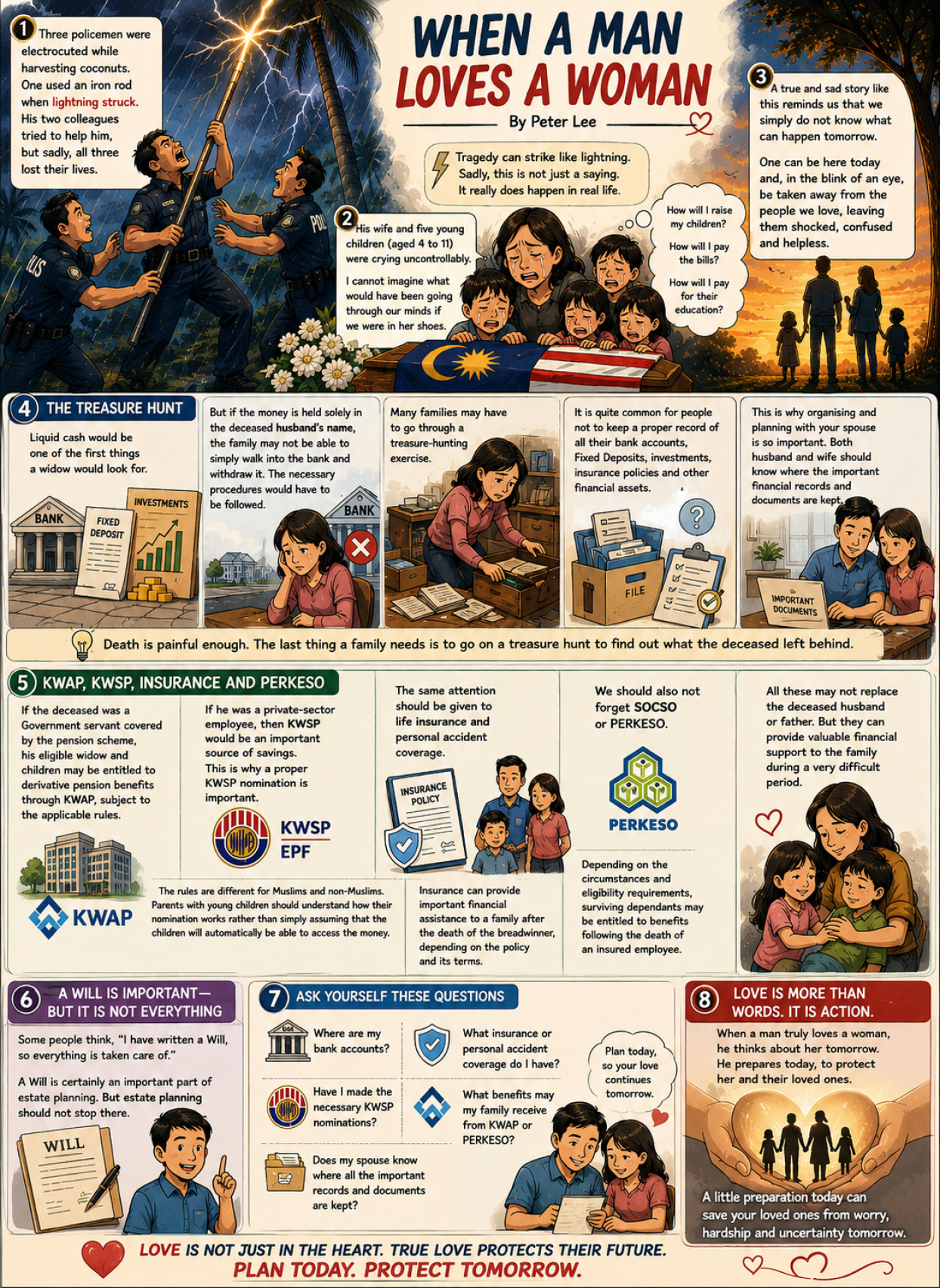
THE TREASURE HUNT
I believe liquid cash would be one of the first things she would look for.
She may look at the money in the bank, Fixed Deposits and other readily available funds.
But if the money is held solely in the deceased husband’s name, the family may not be able to simply walk into the bank and withdraw it. The necessary procedures would have to be followed.
This may sound simple. After all, everyone would say, “Surely the family knows where his bank accounts are.”
But in reality, many families may have to go through a treasure-hunting exercise.
It is quite common for people not to keep a proper record of all their bank accounts, Fixed Deposits, investments, insurance policies and other financial assets.
This is why organising and planning with your spouse is so important.
Both husband and wife should know where the important financial records and documents are kept.
Death is painful enough. The last thing a family needs is to go on a treasure hunt to find out what the deceased left behind.
KWAP, KWSP, INSURANCE AND PERKESO
The next question would naturally be:
“What about his retirement money and other benefits?”
If the deceased was a Government servant covered by the pension scheme, his eligible widow and children may be entitled to derivative pension benefits through KWAP, subject to the applicable rules.
If he was a private-sector employee, then KWSP would be an important source of savings.This is why a proper KWSP nomination is important. The rules are different for Muslims and non-Muslims, and parents with young children should understand how their nomination works rather than simply assuming that the children will automatically be able to access the money themselves.
The same attention should be given to life insurance and personal accident coverage.
Insurance can provide important financial assistance to a family after the death of the breadwinner, depending on the policy and its terms. Again, the nomination and policy details should be properly reviewed and kept where the family can find them.
We should also not forget SOCSO or PERKESO. Depending on the circumstances and eligibility requirements, surviving dependants may be entitled to benefits following the death of an insured employee.
All these may not replace the deceased husband or father.
But they can provide valuable financial support to the family during a very difficult period.
A WILL IS IMPORTANT — BUT IT IS NOT EVERYTHING
This brings me to an important point.
Some people think:
“I have written a Will, so everything is taken care of.”
A Will is certainly an important part of estate planning.
But estate planning should not stop there.
We should also ask ourselves:
Where are my bank accounts?
Have I made the necessary KWSP nominations?
What insurance or personal accident coverage do I have?
What benefits may my family receive from KWAP or PERKESO?
Does my spouse know where all these documents are kept?
These may sound like simple questions.
But when death comes unexpectedly, these simple questions can become extremely important.
WHEN A MAN LOVES A WOMAN
Estate planning is therefore not merely about writing a Will and deciding who gets what after we are gone.
It is also about asking ourselves:
“If I am no longer here tomorrow, will the people I love be able to carry on?”
We cannot prevent every tragedy.
We cannot control when our time will come.
But we can prepare.
We can organise our affairs.
We can make the necessary nominations.
We can have adequate protection.
We can make sure our spouse knows where everything is.
And we can write a Will.
Because love is not only about what we say when we are alive.
Sometimes, love is about what we prepare for the people we leave behind.
When a man loves a woman, he does not merely hope that she will be alright after he is gone.
He prepares for it.
Because even when he is no longer there to hold her hand, he wants to make sure that she and their children can still move forward.
That, to me, is also what it means when a man loves a woman.