
I WAS BORN TO LOVE YOU
(Inspired by the song “I was born to love you”)
By Peter Lee
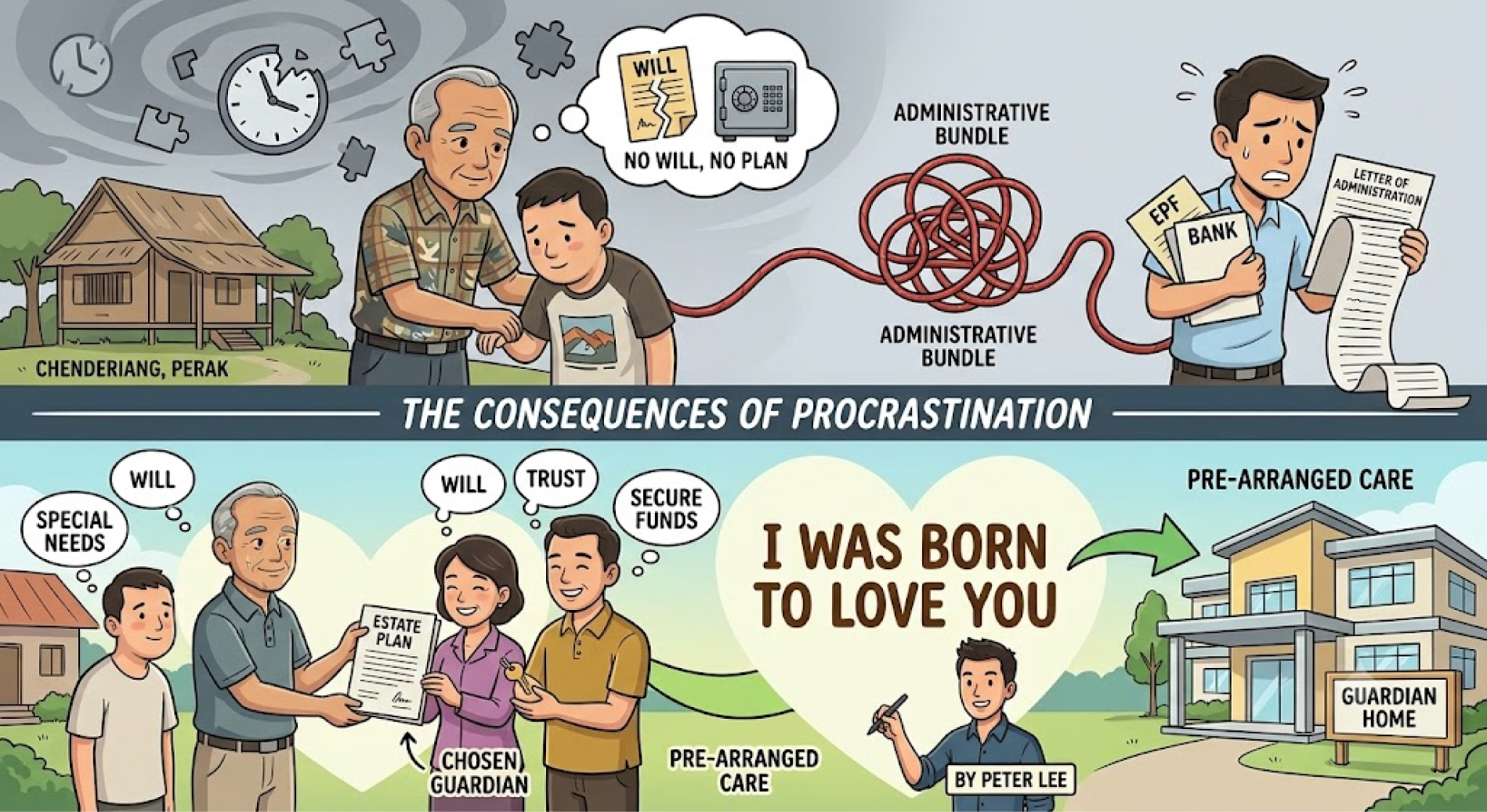
Even though I have been in the estate planning industry for more than two decades, there are times when I feel helpless watching clients and friends struggle with complex estate problems especially when mentally challenged family members and financial constraints are involved.
A friend called me one day asking if I knew of any welfare home around Ipoh that could care for his nephew, a man in his 30s who has special needs. I told him I would contact an NGO to recommend a suitable home, but first I asked, “What happened to his parents?”
My friend explained that his nephew’s mother had passed away when the boy was just a few years old. Since then, his brother the father cared for the son like a baby. Despite repeated reminders from relatives to train the son in basic life skills like self-feeding and personal hygiene, the father protected him continuously until his sudden death.
When the father died, my friend who works part-time and has limited resourcesbecame the nephew’s only lifeline. What followed was a frantic three-week search for a welfare facility while the nephew remained stranded alone in his village home in Chenderiang, Perak.
To make matters worse, my friend’s brother died intestate—without a Will. There was cash in his bank accounts and no nomination made for his EPF funds. My friend was completely at a loss on how to unlock these assets to fund his nephew’s ongoing care.
I explained that he would need to apply for a Letter of Administration (LA) through the High Court. Under the Malaysian Distribution Act 1958 (Amended in 1997), when a deceased leaves behind a spouse, parents, and children, the statutory distribution is to the spouse, to the parents, and to the children.
Because the mother and grandparents had passed away years earlier, the nephew was legally entitled to 100% of the estate. However, the High Court process became tedious and lengthy. My friend had to source and submit death certificates for both the deceased wife and parents to prove to the court that their statutory claims no longer existed. Additionally, he had to produce medical evidence showing his nephew’s mental condition rendered him incapable of managing his own financial affairs all so my friend could be appointed as the legal Administrator.
In my line of work, this is a recurring tragedy when families procrastinating on estate planning even when a crisis is staring them in the face. Many fall into a “self-denial syndrome,” hoping things will somehow work themselves out. In reality, they are passing a financial and administrative time bomb to relatives who are ill-prepared to shoulder the responsibility.
Even families with ample financial means neglect this crucial step. If you have a family member with special needs, proactive planning is essential:
- Identify a Willing Guardian & Trustee: Talk openly with family members who can step up to manage finances and physical care upon your passing.
- Confirm Financial Sufficiency: Ensure your appointed guardian knows that adequate funds have been earmarked such as through a joint bank for legal clearance. Relatives are far more willing to accept the responsibility of guardianship when they know they won’t face financial strain.
- Pre-arrange Care Facilities: If family members cannot provide personal daily care, make preliminary arrangements with a trusted nursing home or care centre during your lifetime.
Estate planning gives you the legal power to appoint your preferred Executors and Guardians, set up a testamentary trust, and establish clear guidelines on how funds should be disbursed throughout your child’s lifetime.
Making these decisions amid difficult circumstances is never easy. But as parents, we all want the absolute best for our children—and taking the step to plan ahead sends a message as enduring as the song title: “I was born to love you.”